300-215 Exam Guide
This 300-215 exam focuses on practical knowledge and exam application scenarios related to the subject area. It evaluates your ability to understand core concepts, apply best practices, and make informed decisions in realistic situations rather than relying solely on memorization.
This page provides a structured exam guide, including exam focus areas, skills measured, preparation recommendations, and practice questions with explanations to support effective learning.
Exam Overview
The 300-215 exam typically emphasizes how concepts are used in professional environments, testing both theoretical understanding and practical problem-solving skills.
Skills Measured
- Understanding of core concepts and terminology
- Ability to apply knowledge to practical scenarios
- Analysis and evaluation of solution options
- Identification of best practices and common use cases
Preparation Tips
Successful candidates combine conceptual understanding with hands-on practice. Reviewing measured skills and working through scenario-based questions is strongly recommended.
Practice Questions for 300-215 Exam
The following practice questions are designed to reinforce key 300-215 exam concepts and reflect common scenario-based decision points tested in the certification.
Question#2
Refer to the exhibit.
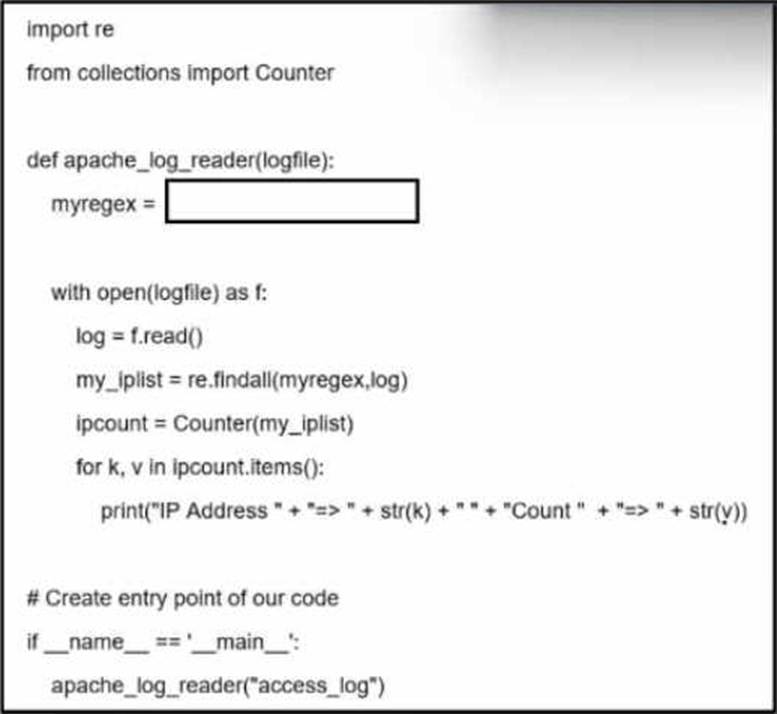
A network administrator creates an Apache log parser by using Python.
What needs to be added in the box where the code is missing to accomplish the requirement?
A. r'\d(1,3),\d(1.3),\d{13}.df{1,3}'
B. r'*\b'
C. r''\b{1-9}[0-9}\b'
D. r'\d{1,3}.\d{1,3}.\d{1,3}.\d{1,3}'
Explanation:
The goal of the given Python code is to parse an Apache access log and extract IP addresses using regular expressions (regex). In this context, the most appropriate regex pattern to extract IPv4 addresses from log data is: r'\d{1,3}.\d{1,3}.\d{1,3}.\d{1,3}'
This pattern matches typical IPv4 addresses, where each octet consists of 1 to 3 digits separated by periods .
For example, it matches addresses like 192.168.1.1 or 10.0.0.123.
The pattern uses:
\d{1,3} to capture between 1 and 3 digits , \. to match the dot (escaped since. is a special character in regex), repeated 4 times with proper separation to form the full IPv4 structure.
Options A, B, and C either include incorrect syntax, improper escape sequences, or do not represent a valid IP address pattern.
This type of log analysis and pattern extraction is described in the Cisco CyberOps Associate curriculum under basic scripting and automation techniques used in log and artifact analysis.
Question#5
Refer to the exhibit.
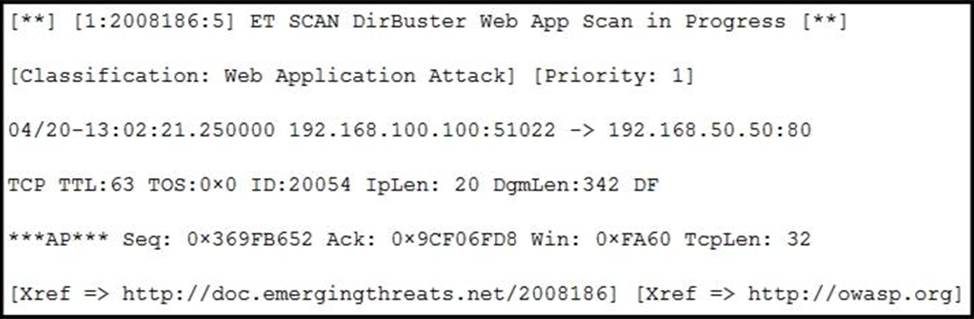
According to the SNORT alert, what is the attacker performing?
A. brute-force attack against the web application user accounts
B. XSS attack against the target webserver
C. brute-force attack against directories and files on the target webserver
D. SQL injection attack against the target webserver
Explanation:
The alert clearly identifies ET SCAN DirBuster Web App Scan in Progress, referencing SID 2008186, which is a Snort signature that specifically detects DirBuster activity. DirBuster is a well-known tool used for brute-forcing hidden directories and files on web servers.
The Cisco CyberOps Associate guide and OWASP both identify directory brute-forcing as a reconnaissance technique to find unprotected or misconfigured endpoints on web applications, typically prior to launching deeper attacks .
Therefore, the correct interpretation of the alert is:
C. brute-force attack against directories and files on the target webserver.
Disclaimer
This page is for educational and exam preparation reference only. It is not affiliated with Cisco, CCNP Cybersecurity, or the official exam provider. Candidates should refer to official documentation and training for authoritative information.


