300-410 Online Practice Questions

Home / Cisco / 300-410

Latest 300-410 Exam Practice Questions

The practice questions for 300-410 exam was last updated on 2026-04-10 .

Viewing page 1 out of 15 pages.

Viewing questions 1 out of 79 questions.

Question#1

DRAG DROP
Drag and drop the actions from the left into the correct order on the right to configure a policy to avoid following packet forwarding based on the normal routing path.


A. 

Explanation:
https://community.cisco.com/t5/networking-documents/how-to-configure-pbr/ta-p/3122774

Question#2

Refer to the exhibit.


R1 is configured with IP SLA to check the availability of the server behind R6 but it kept failing.
Which configuration resolves the issue?

A. R6(config)# ip sla responder
B. R6(config)# ip sla responder udp-echo ip address 10.10.10.1 port 5000
C. R6(config)# ip access-list extended DDOS R6(config ext-nac)# 5 permit icmp host 10.66 66.66 host 10.10.10.1
D. R6(config)# ip access-list extended DDOS R6(config ext-nac)# 5 permit icmp host 10.10.10.1 host 10.66.66.66

Explanation:
In this IP SLA tracking, we don’t need a IP SLA Responder so the command “ip sla responder” on R6 is not necessary.
We also notice that the ACL is blocking ICMP packets on both interfaces E0/0 & E0/1 of R6 so we need
to allow ICMP from source 10.10.10.1 to destination 10.66.66.66.

Question#3

An engineer configured a Cisco router to send reliable and encrypted notifications for any events to the management server. It was noticed that the notification messages are reliable but not encrypted.
Which action resolves the issue?

A. Configure all devices for SNMPv3 informs with priv.
B. Configure all devices for SNMPv3 informs with auth.
C. Configure all devices for SNMPv3 traps with auth.
D. Configure all devices for SNMPv3 traps with priv.

Explanation:
SNMP notifications can be sent as traps or inform requests. Traps are unreliable because the receiver does not send acknowledgments when this device receives traps.”Send reliable and encrypted notifications for any events” so it is SNMP notifications. For encryption we need to configure “priv”.

Question#4

Which feature is used by LDP in the forwarding path within the MPLS cloud?

A. IP forwarding
B. TTL
C. TDP
D. LSP

Question#5

A network administrator is troubleshooting a high utilization issue on the route processor of a router that was reported by NMS The administrator logged into the router to check the control plane policing and observed that the BGP process is dropping a high number of routing packets and causing thousands of routes to recalculate frequently.
Which solution resolves this issue?

A. Police the cir for BGP, conform-action transmit, and exceed action transmit.
B. Shape the pir for BGP, conform-action set-prec-transmit, and exceed action set-frde-transmit.
C. Shape the cir for BG
D. conform-action transmit, and exceed action transmit.
E. Police the pir for BGP, conform-action set-prec-transmit, and exceed action set-clp-transmit.

Explanation:
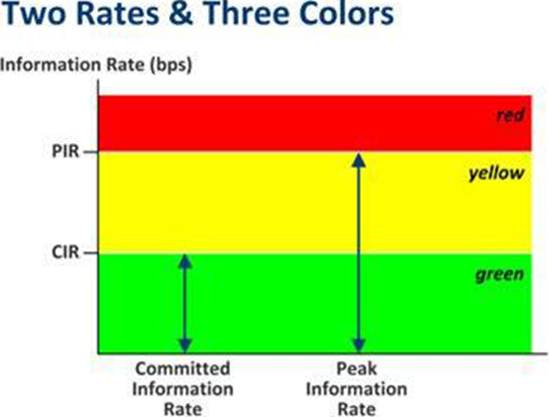
CIR (Committed Information Rate) is the minimum guaranteed traffic delivered in the network.
PIR (Peak Information Rate) is the top bandwidth point of allowed traffic in a non busy times without any guarantee.


+ Policing: is used to control the rate of traffic flowing across an interface. During a bandwidth exceed (crossed the maximum configured rate), the excess traffic is generally dropped or remarked. The result of traffic policing is an output rate that appears as a saw-tooth with crests and troughs. Traffic policing can be applied to inbound and outbound interfaces. Unlike traffic shaping, QoS policing avoids delays due to queuing. Policing is configured in bytes.
+ Shaping: retains excess packets in a queue and then schedules the excess for later transmission over increments of time. When traffic reaches the maximum configured rate, additional packets are queued instead of being dropped to proceed later. Traffic shaping is applicable only on outbound interfaces as buffering and queuing happens only on outbound interfaces. Shaping is configured in bits per second.
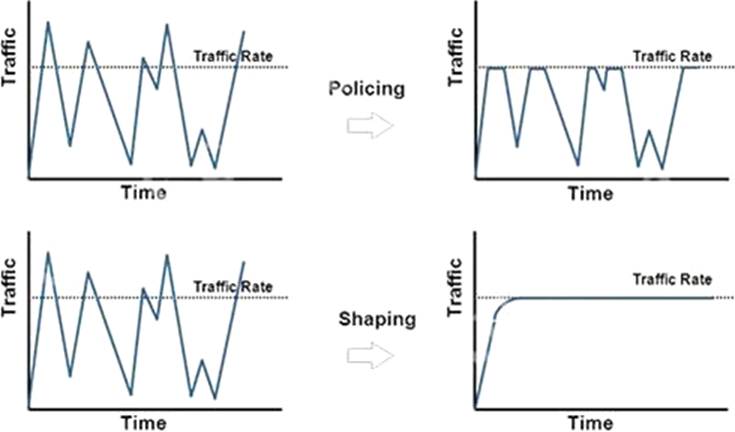


Therefore in this case we can only policing, not shaping as traffic shaping is applicable only on outbound interfaces as buffering and queuing happens only on outbound interfaces. Moreover, BGP traffic is not important so we can drop the excess packets without any problems.
And we only policing the PIR traffic so that the route processor is not overwhelmed by BGP calculation.
Note: The “set-prec-transmit” is the same as “transmit” command except it sets the IP Precedence level as well. The “set-clp-transmit” sets the ATM Cell Loss Priority (CLP) bit from 0 to 1 on the ATM cell and transmits the packet.


Disclaimer

This page is for educational and exam preparation reference only. It is not affiliated with Cisco, CCNP Enterprise, or the official exam provider. Candidates should refer to official documentation and training for authoritative information.

Exam Code: 300-410Q & A: 640 Q&AsUpdated:  2026-04-10

  Get All 300-410 Q&As
