AI-500 Exam Guide
This AI-500 exam focuses on practical knowledge and exam application scenarios related to the subject area. It evaluates your ability to understand core concepts, apply best practices, and make informed decisions in realistic situations rather than relying solely on memorization.
This page provides a structured exam guide, including exam focus areas, skills measured, preparation recommendations, and practice questions with explanations to support effective learning.
Exam Overview
The AI-500 exam typically emphasizes how concepts are used in professional environments, testing both theoretical understanding and practical problem-solving skills.
Skills Measured
- Understanding of core concepts and terminology
- Ability to apply knowledge to practical scenarios
- Analysis and evaluation of solution options
- Identification of best practices and common use cases
Preparation Tips
Successful candidates combine conceptual understanding with hands-on practice. Reviewing measured skills and working through scenario-based questions is strongly recommended.
Practice Questions for AI-500 Exam
The following practice questions are designed to reinforce key AI-500 exam concepts and reflect common scenario-based decision points tested in the certification.
Question#1
You have a Microsoft Foundry multi-agent customer support solution that retrieves grounding data from a shared vector index. The indexed corpus contains product runbooks in Markdown and support articles in HTML Both document types use a consistent hierarchical markup.
You discover that current fixed-size token chunking creates chunks that cross section boundaries.
You need to recommend a chunking approach for the ingestion pipeline. The solution must preserve existing document structure boundaries and minimize custom chunking code.
What should you recommend?
A. fixed-size chunking with token overlap
B. format-specific chunking with header splitters
C. recursive character chunking with structure-aware separators
D. semantic chunking with topic-shift detection
Explanation:
The corpus already contains reliable document hierarchy in Markdown and HTML, so the ingestion pipeline should preserve those author-defined boundaries rather than infer new ones from token counts or topic shifts. Format-specific header splitters can divide Markdown by heading levels and HTML by structural headers, producing chunks that align with meaningful sections. This directly solves the current problem of fixed-size token chunks crossing section boundaries and requires less custom logic than building a semantic topic-shift chunker. Recursive character splitting can be configured with structure-aware separators, but it remains a more generic fallback when format-specific structure is already available. Microsoft Azure AI Search guidance recommends exploiting document structure such as headings when chunking.
Therefore B is the most direct and maintainable approach. In production, add telemetry and regression tests around this behavior so changes to prompts, models, tools, or orchestration do not silently alter the intended contract. The selected approach is the one that best matches the platform's native execution semantics.
Official Microsoft reference: Azure AI Search - structure-aware chunking and Markdown indexing
Question#2
You need to design a solution to resolve the Scheduling agent issue.
What should you include in the design?
A. Implement a retry mechanism that uses exponential backoff.
B. Route the tool execution directly to the Lead Orchestrator agent.
C. Route the tool execution directly to the Patient Intake agent.
D. Implement a retry mechanism that uses immediate retries.
Explanation:
The Scheduling agent's MCP server fails transiently during peak load. Microsoft Azure reliability guidance recommends retries with exponential backoff for transient faults so that callers do not immediately repeat requests at the same rate and worsen a temporarily overloaded dependency. Immediate retries can create a retry storm, especially when many agent requests encounter the same service condition. Routing the tool call through a different agent does not remove the underlying MCP dependency and would only add coupling. A well-designed retry policy should normally include a bounded retry count, increasing delay, jitter where appropriate, and respect for server-provided retry guidance when available. The scenario asks which design element directly addresses the timeouts, and exponential backoff is the established resilience pattern for transient service saturation.
Therefore A is the correct choice. At implementation time, the same rule should be expressed through the framework or service configuration rather than left only as a natural-language convention. That makes the behavior repeatable across runs, easier to test, and less sensitive to model variability.
Official Microsoft reference: Azure Well-Architected Framework - Handle transient faults Topic 3, Standalone Questions
Question#3
HOTSPOT
You have a Microsoft Foundry multi-agent solution. The solution includes an orchestrator that uses Azure Al Search as a semantic cache to shortlist agents and invokes the top match.
You have a version-controlled repository that contains a curated dataset, expected routing, and expected responses. A pull request adds an agent named Agent 1, new sample utterances, and a changed selector prompt.
You need to configure an automated prerelease evaluation gate for the pull request .
The solution must meet the following requirements:
• Validate the integrated system response after the new agent is available to orchestration.
• Validate the semantic cache retrieval quality against the expected results.
• Keep regression tests aligned with the pull request changes.
How should you configure the evaluation gate? To answer, select the appropriate options in the answer area. NOTE: Each correct selection is worth one point.
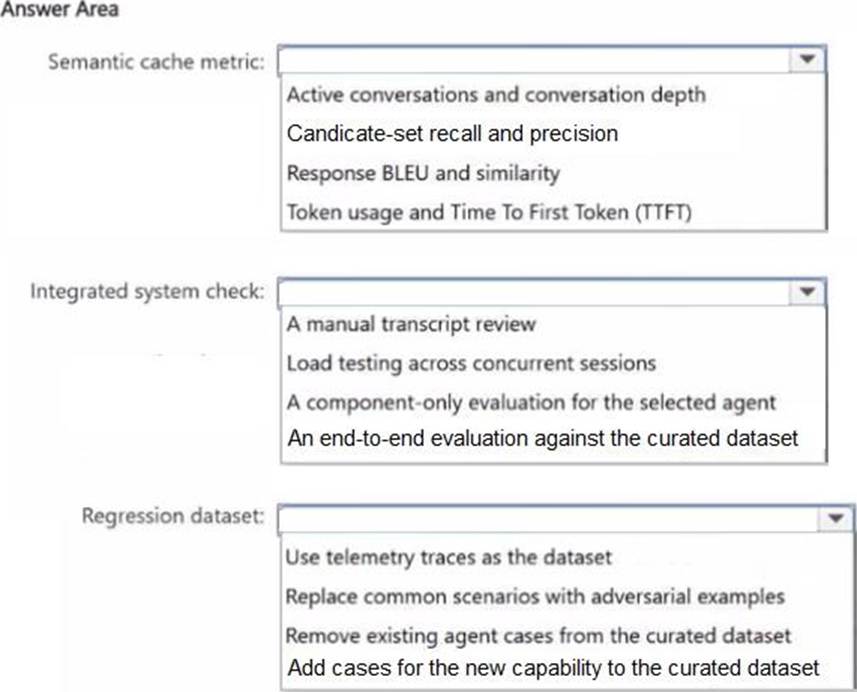
A.
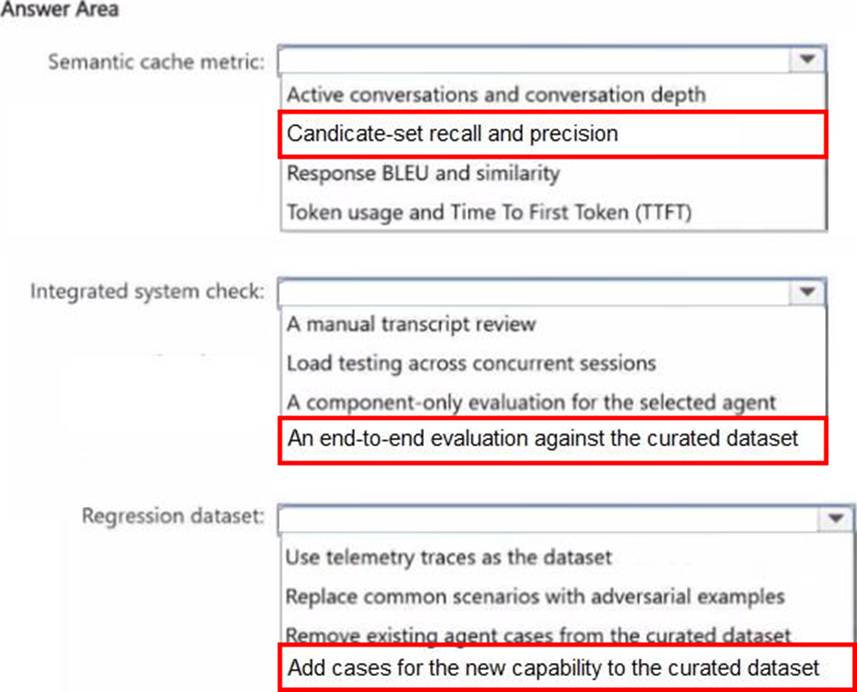
Explanation:
Semantic cache metric: Candidate-set recall and precision; Integrated system check:
An end-to-end evaluation against the curated dataset; Regression dataset: Add cases for the new capability to the curated dataset.
The semantic cache is acting as a retrieval/shortlisting component, so recall and precision are the appropriate measures of whether expected agent candidates are surfaced and whether irrelevant candidates are avoided. The pull request also changes the selector prompt and adds an agent, so component-only tests are insufficient; an end-to-end evaluation must exercise retrieval, routing, the new agent, and final response generation together. Finally, the version-controlled regression dataset should evolve with the capability. Adding representative cases for the new agent keeps expected routing and responses aligned with the code and prompt changes in the pull request. Microsoft Foundry evaluation guidance treats curated datasets as reusable regression assets for CI/CD quality gates. Together, these three selections test retrieval quality, integrated behavior, and regression coverage at the correct layers. The evaluation should also preserve correlation identifiers and version information where possible so a failed score can be traced back to the exact agent, model, tool call, or retrieval step that produced it. This turns the metric into an actionable diagnostic rather than only a dashboard number. Official Microsoft reference: Microsoft Foundry - evaluation datasets and CI/CD evaluation
Question#4
You have a LangGraph multi-agent workflow that uses Azure Cosmos DB as a checkpointer.
You plan to change the pruning rules for the running message list before the next release
You need to implement evaluations tor memory .
The solution must meet the following requirements:
• Verify that claim-related state values remain correct at transition points.
• Verify that conversation context is preserved after an interruption.
• Identify the source of any loss of continuity during a run
Which three actions should you perform Each correct answer presents part of the solution NOTE: Each correct selection is worth one point.
A. Store the expected values in short-term memory and remove durable external artifacts before each run.
B. Run each turn with a different threaded and evaluate the final response text for the case.
C. Capture the tool.call.arguments and tool.call.results attributes as the memory evaluation data for each tool invocation.
D. Run a scripted multi-turn case through all the agents by using a single thread id before and after a process restart.
E. Compare the persisted checkpoints documents for the evaluation thread_id with the expected State values after each handoff.
F. Correlate the evaluation run ID with trace spans for agent-to-agent interactions and state management.
Explanation:
Memory evaluation must verify persistence across interruption, correctness of checkpointed state, and enough telemetry to locate where continuity was lost. Running a scripted multi-turn case with one stable `thread_id` before and after a restart directly tests whether the Cosmos-backed LangGraph checkpointer restores the same conversation/workflow. Comparing persisted checkpoint documents with expected state values at each handoff verifies that claim-related state has not been corrupted by the new pruning rules. Correlating the evaluation run with trace spans then provides the diagnostic path to identify which agent transition or state-management operation caused a failure. Changing the thread ID each turn would intentionally create separate state scopes, and removing durable artifacts would defeat the persistence test. Tool-call arguments alone do not prove workflow-memory continuity. Therefore D, E, and F are the complementary actions required. The evaluation should also preserve correlation identifiers and version information where possible so a failed score can be traced back to the exact agent, model , tool call, or retrieval step that produced it. This turns the metric into an actionable diagnostic rather than only a dashboard number.
Official Microsoft reference: Azure Cosmos DB integrations for LangGraph and agent state
Disclaimer
This page is for educational and exam preparation reference only. It is not affiliated with Microsoft, Microsoft Certified: Multi-Agent AI Solutions Expert, or the official exam provider. Candidates should refer to official documentation and training for authoritative information.


