AgilePM Practitioner Exam Guide
This AgilePM Practitioner exam focuses on practical knowledge and exam application scenarios related to the subject area. It evaluates your ability to understand core concepts, apply best practices, and make informed decisions in realistic situations rather than relying solely on memorization.
This page provides a structured exam guide, including exam focus areas, skills measured, preparation recommendations, and practice questions with explanations to support effective learning.
Exam Overview
The AgilePM Practitioner exam typically emphasizes how concepts are used in professional environments, testing both theoretical understanding and practical problem-solving skills.
Skills Measured
- Understanding of core concepts and terminology
- Ability to apply knowledge to practical scenarios
- Analysis and evaluation of solution options
- Identification of best practices and common use cases
Preparation Tips
Successful candidates combine conceptual understanding with hands-on practice. Reviewing measured skills and working through scenario-based questions is strongly recommended.
Practice Questions for AgilePM Practitioner Exam
The following practice questions are designed to reinforce key AgilePM Practitioner exam concepts and reflect common scenario-based decision points tested in the certification.
Question#1
The Close Out of Timebox B was completed as scheduled, but the Could Have requirement of tiled walls in the bathrooms was NOT delivered within this period, with the
agreement of the team.
Which Agile principle MOST influences this course of action?
A. Deliver on time.
B. Never compromise quality.
C. Build incrementally from firm foundations.
D. Develop iteratively.
Question#2
During the Foundations phase for Project Increment 4, Sukra Aroon held a meeting with Hira, Mira Bachar, andWanida Anong, to ensure alignment and compliance with EPR company policies, local regulations, and international standards. The meeting also clarified how financial and investment decisions would be made for Project Increment 4, ensuring alignment with EPR business priorities, and how this information will be tracked, controlled and evidenced.
Wanida Anong, who works across multiple sites worldwide, attended the meeting in person but has limited availability throughout the Project Increment.
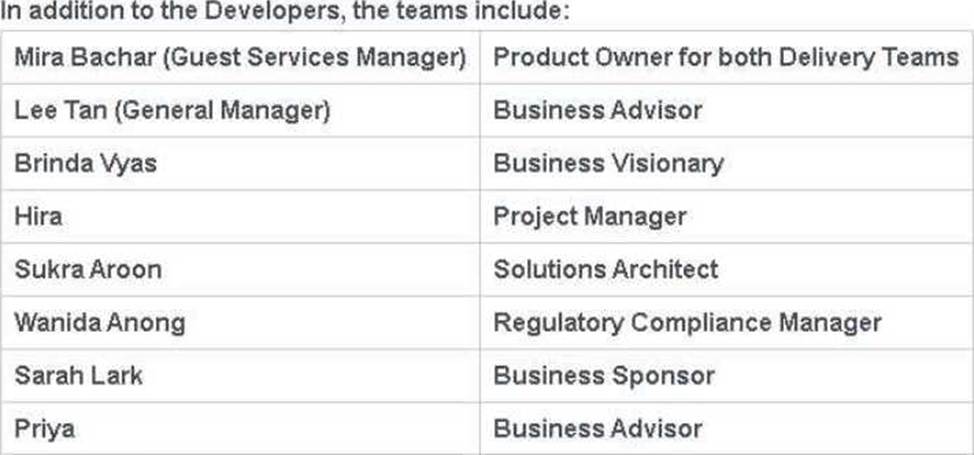
During the meeting, Wanida Anong shared specific safety and hygiene standards associated with the water used for Hydrotherapy treatments. Water quality needs to be monitored to ensure it meets specific safety and hygiene standards.
Which of the following approaches balances agility with compliance?
A. Fully design the Hydrotherapy solution during the Foundations phase and validate it with the regulatory authority before development starts.
B. Have Wanida Anong involved in all Product Backlog refinement, Sprint Planning, and Sprint Review activities that impact the design and operation of these treatments.
C. Include regulatory acceptance criteria in the Definition of Done for all Product Backlog items, review and get acceptance of compliance at Sprint Reviews.
D. Deliver compliance-related features early in the Project Increment and ensure they are formally reviewed by the regulatory authority leaving the team more time for rework if required.
Explanation:
The correct answer is C.
AgilePM balances agility and compliance by embedding compliance into the way work is defined, built, and reviewed, rather than treating it as a large upfront phase or a late-stage check.
Why C is correct:
By including regulatory acceptance criteria in the Definition of Done, compliance becomes part of normal delivery quality.
This ensures the team does not separate “done” from “compliant.”
Reviewing compliance through Sprint Reviews supports incremental inspection and early detection of issues.
This is a strong AgilePM response because it:
keeps compliance visible,
integrates it into iterative delivery,
reduces the risk of late surprises,
and supports evidence-based control.
Why the other options are not the best:
A is too upfront and predictive. AgilePM does not require full design before development starts.
B may sound collaborative, but it is impractical, especially since Wanida has limited availability.
D is useful as a tactic in some contexts, but it is less robust than building compliance directly into the team’s definition of complete work.
So the best answer is C.
Question#3
How should the Project Manager assist the plumbers to deliver the plumbing?
A. Split the entire Solution Development Team into smaller teams covering specific locations of the house.
B. Decide on the location of the radiators on behalf of Architecture Angels.
C. Establish an inter-team competition to see which team can complete first.
D. Approve each Timebox before work continues in the next.
Question#4
Which 2 actions should the Workshop Facilitator take when preparing for the workshop?
A. Ask the Software Developer to provide an estimate of how much storage space would be required to hold photos and videos.
B. Invite the Marketing Director to create a summary of the content they believe the system should hold and why.
C. Assign ownership of the workshop to the Software Developer.
D. Ask the IT Operations Manager to prepare the agenda for the workshop.
E. Research other hotel reservation systems to form an opinion on what the content should be.
Explanation:
The two actions that the Workshop Facilitator should take when preparing for the workshop are:
• A. Ask the Software Developer to provide an estimate of how much storage space would be required to hold photos and videos. This will provide a factual basis for the discussion about the system’s content and its storage requirements.
• B. Invite the Marketing Director to create a summary of the content they believe the system should hold and why. This will ensure that the Marketing Director’s perspective and requirements are clearly understood by all participants in the workshop.
Please note that while the IT Operations Manager, Software Developer, and the Facilitator themselves (options C, D, and E) could contribute valuable input to the workshop, these actions are not necessarily part of the Facilitator’s role in preparing for the workshop. The Facilitator’s role is to guide the discussion, not to assign ownership of the workshop, prepare the agenda, or form opinions on the content.
Question#5
What is a key advantage of using AgilePM for the Hoy Hall Hotel project concerning changing requirements?
A. AgilePM disregards changes once the initial scope is set
B. AgilePM facilitates rigid adherence to set timelines
C. AgilePM provides flexibility to accommodate and prioritize changes
D. AgilePM encourages postponing changes to reduce complexity
Disclaimer
This page is for educational and exam preparation reference only. It is not affiliated with APMG-International, AgilePM, or the official exam provider. Candidates should refer to official documentation and training for authoritative information.


