Financial Management Exam Guide
This Financial Management exam focuses on practical knowledge and exam application scenarios related to the subject area. It evaluates your ability to understand core concepts, apply best practices, and make informed decisions in realistic situations rather than relying solely on memorization.
This page provides a structured exam guide, including exam focus areas, skills measured, preparation recommendations, and practice questions with explanations to support effective learning.
Exam Overview
The Financial Management exam typically emphasizes how concepts are used in professional environments, testing both theoretical understanding and practical problem-solving skills.
Skills Measured
- Understanding of core concepts and terminology
- Ability to apply knowledge to practical scenarios
- Analysis and evaluation of solution options
- Identification of best practices and common use cases
Preparation Tips
Successful candidates combine conceptual understanding with hands-on practice. Reviewing measured skills and working through scenario-based questions is strongly recommended.
Practice Questions for Financial Management Exam
The following practice questions are designed to reinforce key Financial Management exam concepts and reflect common scenario-based decision points tested in the certification.
Question#1
What is the main responsibility of the Financial Industry Regulatory Authority (FINRA)?
A. Regulating brokerage firms and exchange markets
B. Insuring investor deposits
C. Regulating the Federal Reserve
D. Overseeing the issuance of currency
Explanation:
The Financial Industry Regulatory Authority (FINRA) is a self-regulatory organization responsible for overseeing brokerage firms and registered securities representatives in the United States. Its primary mission is to protect investors and ensure market integrity by enforcing rules governing ethical conduct, disclosure, trading practices, and licensing. FINRA operates under the oversight of the Securities and Exchange Commission (SEC), creating a regulatory structure that combines federal authority with industry expertise. Unlike the FDIC, FINRA does not insure deposits, and unlike the Federal Reserve, it does not manage monetary policy or issue currency. Financial management texts emphasize FINRA’s role in supervising broker-dealers, administering qualification exams, and resolving disputes through arbitration and mediation.
Option A correctly identifies FINRA’s core responsibility.
Question#2
Why would a company choose to maintain a certain level of cash as a reserve balance?
A. To pay for major capital expenditures without external financing
B. To distribute as dividends at the end of the fiscal year
C. To safeguard against unforeseen expenses and maintain liquidity
D. To cover the cost of repurchasing shares from the stock market
Explanation:
Maintaining a cash reserve is a core element of prudent working capital management. Firms hold cash to meet transaction needs, precautionary needs, and sometimes speculative opportunities. The precautionary motive is particularly important, as it allows firms to handle unexpected expenses, revenue shortfalls, or economic disruptions without relying on costly external financing. Adequate liquidity reduces the risk of financial distress and enhances operational flexibility. Financial management theory emphasizes balancing the opportunity cost of holding cash against the benefits of liquidity.
Option C accurately reflects this precautionary and liquidity-focused rationale.
Question#3
Why might investors choose to invest in junk bonds?
A. They offer guaranteed returns with minimal risk.
B. They offer the potential for higher returns in exchange for higher risk.
C. They always outperform the stock market in terms of returns.
D. They are backed by government guarantees.
Explanation:
Junk bonds, also known as high-yield bonds, are issued by firms with lower credit ratings and therefore higher default risk. To compensate investors for this additional risk, these bonds offer higher interest rates than investment-grade bonds. From a financial management and portfolio perspective, investors may include junk bonds to enhance portfolio returns, particularly when they believe default risk is overstated or when economic conditions are favorable. Junk bonds do not guarantee returns and are not backed by government guarantees, making options A and D incorrect. They also do not consistently outperform equities, especially during periods of financial stress.
Option B accurately reflects the riskCreturn tradeoff that underpins investment decisions in capital market theory: higher expected returns are associated with higher risk.
Question#4
Ratios for Freedom Rock Bicycles are shown below, along with industry average ratios.
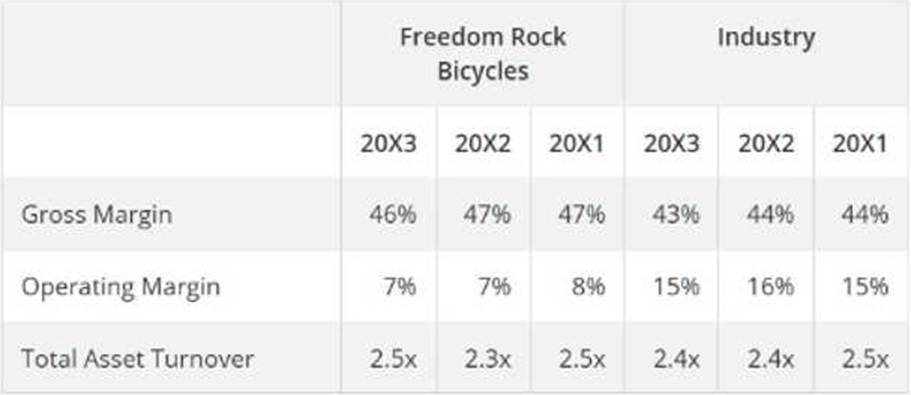
What are appropriate recommendations for Freedom Rock Bicycles based on this analysis?
A. To increase production expenses and invest in more assets
B. To maintain current operating expenses and reduce asset levels to be in line with the industry
C. To reduce non-production expenses and evaluate the company’s fixed costs
D. To focus solely on increasing gross margins to match industry levels
Explanation:
The data show that Freedom Rock Bicycles has gross margins comparable to or slightly above the industry but significantly lower operating margins. This indicates that the problem is not production efficiency or cost of goods sold, but rather operating expenses such as selling, general, and administrative costs or fixed overhead. Additionally, asset turnover is roughly in line with industry averages, suggesting that asset utilization is not the primary issue. From a financial management perspective, when gross margin is healthy but operating margin lags, the logical focus is on controlling non-production costs and evaluating fixed cost structures. Reducing unnecessary overhead, improving operating efficiency, or restructuring fixed expenses can directly improve operating margin and overall profitability.
Option C best reflects this targeted, ratio-driven recommendation. The other options either misdiagnose the problem or focus on areas already performing adequately relative to peers.
Question#5
What does a high inventory turnover ratio indicate about a company’s inventory management?
A. The company’s inventory is obsolete.
B. The company has efficient inventory management.
C. The company has excess inventory.
D. The company has too little inventory.
Explanation:
Inventory turnover measures how many times a company sells and replaces its inventory during a given period. A high inventory turnover ratio generally indicates that inventory is being sold quickly and efficiently, minimizing holding costs such as storage, insurance, and obsolescence. From a financial management perspective, efficient inventory management improves cash flow by reducing capital tied up in unsold goods and shortens the cash conversion cycle. While an extremely high turnover could signal stockouts or lost sales, financial management texts typically interpret higher turnover―relative to industry norms―as a positive indicator of operational efficiency.
Option B correctly reflects this standard interpretation.
Disclaimer
This page is for educational and exam preparation reference only. It is not affiliated with WGU, Courses and Certificates, or the official exam provider. Candidates should refer to official documentation and training for authoritative information.


