HPE7-V01 Exam Guide
This HPE7-V01 exam focuses on practical knowledge and exam application scenarios related to the subject area. It evaluates your ability to understand core concepts, apply best practices, and make informed decisions in realistic situations rather than relying solely on memorization.
This page provides a structured exam guide, including exam focus areas, skills measured, preparation recommendations, and practice questions with explanations to support effective learning.
Exam Overview
The HPE7-V01 exam typically emphasizes how concepts are used in professional environments, testing both theoretical understanding and practical problem-solving skills.
Skills Measured
- Understanding of core concepts and terminology
- Ability to apply knowledge to practical scenarios
- Analysis and evaluation of solution options
- Identification of best practices and common use cases
Preparation Tips
Successful candidates combine conceptual understanding with hands-on practice. Reviewing measured skills and working through scenario-based questions is strongly recommended.
Practice Questions for HPE7-V01 Exam
The following practice questions are designed to reinforce key HPE7-V01 exam concepts and reflect common scenario-based decision points tested in the certification.
Question#1
Your customer wants to implement an HPE SimpliVity stretched cluster spanning two sites to improve availability.
You are reviewing an HPE SimpliVity proposal that consists of the following components:
✑ 12 HPE SimpliVity 380 Gen11 nodes, 8 for the primary site and 4 for the remote site, all of which have 2 CPUs, 16 cores each
✑ 12 HPE OneView Advanced licenses
✑ 2 HPE Alletra Storage MP B10000, 1 for the primary site and 1 for the remote site
✑ 384 core VMware vSphere Standard subscriptions
✑ Two pairs of ArubaOS-CX 8325 switches
Which statement about this proposal is true?
A. Additional VMware subscriptions should be added, as the HPE SimpliVity 380 Gen11 core count is higher than needed.
B. In order to enable DRS functionality, vSphere Standard subscriptions should be replaced with vSphere Foundation subscriptions.
C. A Remote Copy license should be activated on all HPE Alletra arrays to enable remote HPE SimpliVity backups.
D. Aruba OS-CX 8325 should be enhanced with a Pensando license so HPE SimpliVity traffic can be secured.
Explanation:
The correct answer is B. The proposal includes VMware vSphere Standard subscriptions, but the requirement context is a stretched, availability-focused HPE SimpliVity design. Distributed Resource Scheduler is an advanced VMware function used for automated VM placement and load balancing across hosts. VMware’s product-line comparison shows Distributed Resource Scheduler under Enterprise Plus and vSphere Foundation feature sets, while vSphere Standard does not provide that capability. Therefore, if the customer requires DRS functionality, vSphere Standard must be replaced with an edition that includes DRS, such as vSphere Foundation.
Option A is incorrect because the listed core count is aligned with 12 nodes x 2 CPUs x 16 cores, which totals 384 cores; the issue is not missing core quantity.
Option C is incorrect because HPE Alletra Remote Copy licensing is unrelated to enabling HPE SimpliVity backup behavior.
Option D is not required to make a SimpliVity stretched cluster valid; Pensando is a distributed services/security acceleration technology, not a prerequisite for SimpliVity stretched-cluster traffic. Reference/topics: proposal validation, VMware subscription selection, SimpliVity stretched cluster design, licensing alignment.
Question#2
Your customer is in the early stages of an AI project. They are requesting a POC demonstrating how they can utilize on-prem data with a limited amount of rack space, in an air-cooled environment.
Performance with the AI use case of Retrieval-Augmented Generation (RAG) will be the primary factor in their decision making.
Which HPE Compute offering would be suitable in this scenario?
A. HPE ProLiant Compute DL560a Gen12 with NVIDIA H200 NVL GPUs.
B. HPE ProLiant Compute DL384 Gen12 with NVIDIA GH200 NVL2.
C. HPE ProLiant Compute DL320 Gen11 with NVIDIA L4 GPUs.
D. HPE Cray XD670 with NVIDIA H200 Tensor Core GPUs.
Explanation:
The correct answer is C because the customer’s requirement is for an early-stage AI proof of concept, on-prem data usage, limited rack space, and an air-cooled environment. HPE ProLiant DL320 Gen11
with NVIDIA L4 GPUs is a compact, rack-efficient platform suitable for AI inference and edge-style workloads. HPE describes the DL320 Gen11 as a compact 1U platform that can support up to four NVIDIA L4 Tensor Core GPUs, making it appropriate for space-constrained AI inferencing and near-real-time insight use cases. RAG workloads often need strong inference performance and local data access, but a POC does not automatically justify large-scale H200, GH200, or Cray-class infrastructure.
Options A and D are much larger, higher-power configurations suited to more demanding AI training or large-scale accelerated-compute requirements.
Option B is also excessive for the stated limited-rack, air-cooled POC profile. The right design is not the most powerful system; it is the platform that matches the workload maturity, thermal limits, footprint, and business validation stage. Reference /topics: AI workload sizing, RAG inferencing, HPE ProLiant DL320 Gen11, NVIDIA L4, POC platform selection.
Question#3
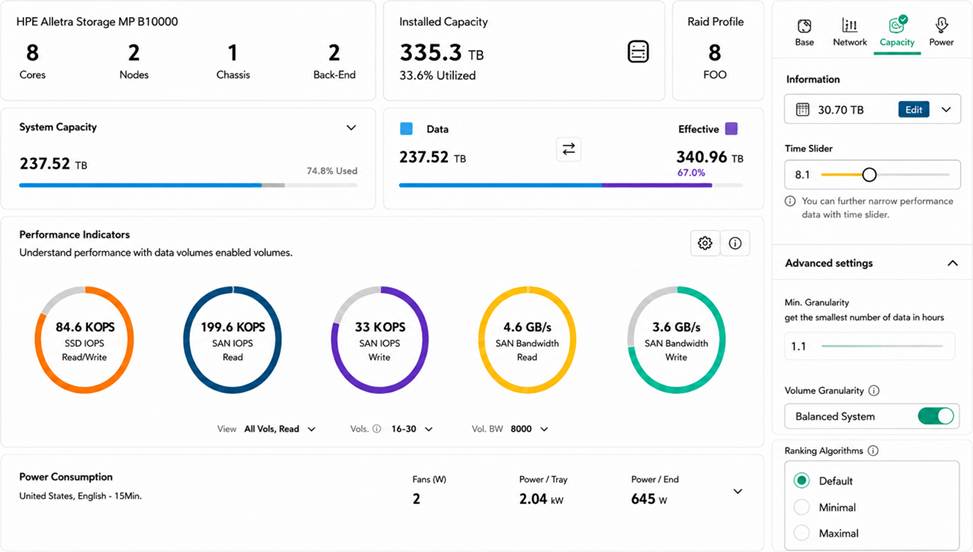
Your customer has a requirement to support 500K IOP/s write speeds in their environment.
What change should you make to the configuration to achieve this?
A. Replace the nodes with B91160 model and add additional drive shelf and more drives.
B. Replace the nodes with B91130 model and add additional drive shelf.
C. Increase the amount of drives supported to achieve the requirement.
D. Replace the nodes with B10230 model and add additional drive shelf and more drives.
Explanation:
The correct answer is D because the requirement is not simply additional raw capacity; it is a write-performance target of 500K IOP/s. For HPE Alletra Storage MP B10000 designs, controller-node model selection, node count, shelf count, drive population, and media layout collectively determine whether the configuration can satisfy the performance envelope. Merely increasing the number of drives, as suggested in option C, does not guarantee that the front-end controller resources, CPU, cache, and back-end connectivity can sustain the required write workload.
Options A and B use lower or inappropriate node selections for this stated requirement. The B10230 model, combined with additional shelf and drive resources, is the configuration change that aligns the controller and media resources with the required write I/O target. HPE’s course outline places HPE Alletra Storage MP B10000 in both general enterprise solution design and database workload solution design, which is exactly the kind of workload-sensitive sizing exercise represented here. The proposal must be validated against the customer’s required I/O profile, not only against usable capacity.
Question#4
Which statement about Omnissa Horizon workloads is correct?
A. Unified Access Gateway allows users to securely access virtual desktops from outside a corporate firewall.
B. Omnissa Horizon is only supported through HPE Compute and only for customers who will run more than 720 virtual desktops.
C .
C. Omnissa Horizon requires vVols for the primary storage. Traditional VMFS datastores can only be used for templates and ISO images.
D. Omnissa Horizon requires GPU resources available on all deployed clusters.
Explanation:
The correct answer is A. Omnissa Unified Access Gateway is the edge access component used with Horizon to provide secure remote access from an external network to internal Horizon desktops and applications. It is commonly positioned in a DMZ and avoids exposing internal Horizon infrastructure directly to external users. Omnissa documentation describes Unified Access Gateway as enabling secure remote access from external networks to Workspace ONE and Horizon resources, and Horizon installation guidance describes it as the default gateway for secure access to remote desktops and applications from outside the corporate firewall.
Option B is incorrect because Horizon support is not limited to a minimum of more than 720 desktops, nor is it only supported through a generic HPE Compute qualification.
Option C is technically wrong because Horizon can use supported VMware datastore types such as VMFS, NFS, and vVols depending on the validated design.
Option D is also wrong because GPU resources are required only for graphics-accelerated use cases, not for every Horizon cluster. Reference/topics: workload requirement analysis, VDI architecture, HPE compute platform positioning, secure access design.
Question#5
Your customer has a networking environment based on Aruba CX 8325 switches configured with Quality of Service settings that give higher priority to iSCSI traffic between HPE ProLiant servers and HPE Alletra 6000 storage.
They are planning to add HPE Synergy frames with HPE Virtual Connect modules that will connect to the same Aruba infrastructure. The servers will be deployed in different VLANs. They need to update their environment to provide a lossless fabric for RoCE traffic that will traverse between the HPE Synergy frames and through multiple switches.
Your customer has two sets of Synergy frames in different logical enclosures connected with Aruba CX 8325 switches. They want to update their environment to provide a lossless fabric for RoCE traffic.
What is the correct environmental or design change that will meet the customer’s new requirement?
A. Use RoCEv1 and configure DCBX on the switch facing the CNA in the servers.
B. Use RoCEv2 and properly design networking map for the Layer 3 interfaces on the path.
C. The Aruba CX 8325 switches must be changed to Aruba CX 8400 to support Data Center Bridging eXchange (DCBX).
D. The HPE Synergy frames must be connected to different switches for RoCE traffic and Ethernet traffic.
Explanation:
The correct answer is B. RoCEv2 is the appropriate choice when RDMA traffic must traverse routed Layer 3 networks, multiple VLANs, and multiple switches. RoCEv1 is Layer 2 only and is therefore unsuitable when the design requires traffic to move between different routed segments or logical enclosures through the data-center network. A lossless RoCEv2 design must be planned end to end: priority flow control, ECN, QoS classification, MTU consistency, and routing paths must be aligned across the server adapters, HPE Synergy Virtual Connect domain, and Aruba CX fabric.
Option A is incorrect because RoCEv1 cannot satisfy the stated Layer 3 traversal requirement.
Option C is incorrect because Aruba CX 8325 is a data-center switch family capable of participating in advanced data-center designs; replacing it with CX 8400 is not inherently required just to support DCBX-style fabric behavior.
Option D creates artificial separation and does not solve the multi-switch lossless-fabric requirement. Reference/topics: RoCEv2, lossless Ethernet, Aruba CX data-center switching, HPE Synergy Virtual Connect networking, workload-driven network design.
Disclaimer
This page is for educational and exam preparation reference only. It is not affiliated with Hewlett Packard Enterprise (HPE), HPE Master ASE - Edge-to-Cloud Architect, or the official exam provider. Candidates should refer to official documentation and training for authoritative information.


