JN0-105 Online Practice Questions

Home / Juniper / JN0-105

Latest JN0-105 Exam Practice Questions

The practice questions for JN0-105 exam was last updated on 2026-02-22 .

Viewing page 1 out of 2 pages.

Viewing questions 1 out of 14 questions.

Question#1

Which two statements are true about the candidate configuration? (Choose two.)

A. Candidate configuration changes are automatically applied.
B. You can deploy multiple changes at the same time.
C. Multiple users cannot modify the same candidate configuration.
D. You can discard changes before committing them.

Explanation:
The candidate configuration in Junos OS is a temporary configuration that allows network administrators to make and stage multiple configuration changes before applying them to the device. This approach enables the deployment of multiple changes in a single operation, ensuring that all configurations work together as intended before making them active. Additionally, the candidate configuration can be discarded if the administrator decides not to apply the staged changes, allowing for a "trial and error" approach without affecting the currently active configuration. This feature provides flexibility and reduces the risk of disruptive changes to the network.

Question#2

You have completed the initial configuration of your new Junos device. You want to be able to load this configuration at a later time.
Which action enables you to perform this task?

A. Enter the load factory-default command.
B. Enter the request system reboot command.
C. Enter the request system zeroize command.
D. Enter the request system configuration rescue save command.

Explanation:
In Junos OS, the request system configuration rescue save command is used to save the current active configuration as a rescue configuration. This feature is particularly useful for preserving a known good configuration state that can be quickly reverted to in case of configuration errors or issues. By saving a rescue configuration, administrators can ensure that they have a reliable fallback option that can be loaded in the future to restore the device's operation without having to reconfigure from scratch. This is an essential practice for maintaining network stability and quick recovery.

Question#3

Click the Exhibit button.
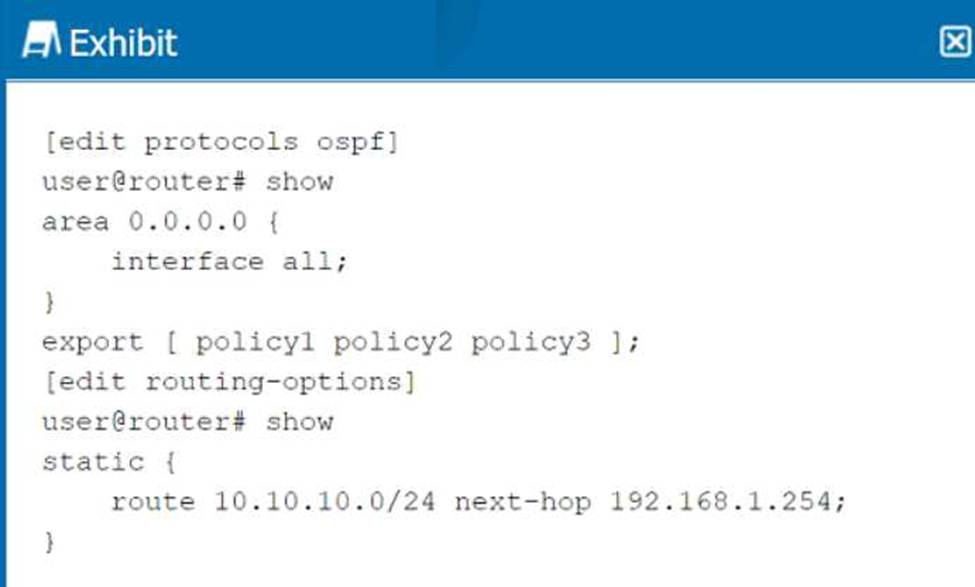


Referring to the exhibit, OSPF has three export policies that match different static route prefixes. The 10.10.10.0/24 static route does not match any terms in the policy1 routing policy.
What happens next in this scenario?

A. The static route is evaluated by the poiicy3 routing policy.
B. The static route is evaluated by the poiicy2 routing policy.
C. The static route is rejected by the default routing policy.
D. The static route is rejected by the policy1 routing policy.

Explanation:
In Junos, when multiple policies are applied to a routing protocol for route export, the routes are evaluated in the order in which the policies are listed. In the exhibit, the OSPF configuration has three export policies listed: policy1, policy2, and policy3. The static route 10.10.10.0/24 does not match any terms in policy1; therefore, it is not rejected by policy1 but is instead passed on to the next policy in the sequence, which is policy2.
If the static route matches a term in policy2 that permits the route, it will be exported into OSPF. If it does not match in policy2, it will then be evaluated by policy3. If there is no match in policy3 as well, and assuming there are no more policies listed, the route would then be subject to the default routing policy behavior, which typically rejects the route unless an explicit accept statement is present in the policies.


Question#4

What are two types of transit traffic that traverse the forwarding plane of a Layer 3 router? (Choose two.)

A. unicast traffic
B. multicast traffic
C. exception traffic
D. broadcast traffic

Explanation:
Transit traffic that traverses the forwarding plane of a Layer 3 router includes both unicast and multicast traffic types. Unicast traffic is directed from a single source to a single destination, while multicast traffic is sent from one source to multiple destinations that are part of a multicast group. These types of traffic are efficiently routed through the network by leveraging the router's forwarding plane capabilities. Exception traffic, which requires special handling by the control plane, and broadcast traffic, which is typically limited to a single broadcast domain and not usually forwarded by Layer 3 routers, are not considered standard types of transit traffic for the forwarding plane of a router.

Question#5

Which two actions happen when multiple users issue the configure exclusive command to enter configuration mode on a Junos device? (Choose two.)

A. Other users can enter configuration mode.
B. The candidate configuration is unlocked.
C. The candidate configuration is locked.
D. Other users cannot enter configuration mode.

Explanation:
In Junos OS, when a user issues the configure exclusive command, it locks the candidate configuration for that user, preventing other users from making concurrent configuration changes. This exclusive lock ensures that configuration changes are managed in a controlled manner, reducing the risk of conflicting changes. As a result, while one user is in exclusive configuration mode, other users are prevented from entering configuration mode until the lock is released, either by the user committing the changes or exiting configuration mode.

Disclaimer

This page is for educational and exam preparation reference only. It is not affiliated with Juniper, JNCIA-Junos, or the official exam provider. Candidates should refer to official documentation and training for authoritative information.

Exam Code: JN0-105Q & A: 111 Q&AsUpdated:  2026-02-22

  Get All JN0-105 Q&As
