FCP_FCT_AD-7.4 Online Practice Questions

Home / Fortinet / FCP_FCT_AD-7.4

Latest FCP_FCT_AD-7.4 Exam Practice Questions

The practice questions for FCP_FCT_AD-7.4 exam was last updated on 2026-03-02 .

Viewing page 1 out of 1 pages.

Viewing questions 1 out of 9 questions.

Question#1

Refer to the exhibit.


Based on the Security Fabric automation settings, what action will be taken on compromised endpoints?

A. Endpoints will be quarantined through EMS
B. Endpoints will be banned on FortiGate
C. An email notification will be sent for compromised endpoints
D. Endpoints will be quarantined through FortiSwitch

Explanation:
Based on the Security Fabric automation settings shown in the exhibit:
The automation stitch is configured with a trigger for a "Compromised Host."
The action specified for this trigger is "Quarantine FortiClient via EMS."
This indicates that when an endpoint is detected as compromised, FortiClient EMS will quarantine
the endpoint as part of the automation process.
Therefore, the action taken on compromised endpoints will be to quarantine them through EMS. Reference
FortiGate Security 7.2 Study Guide, Automation Stitches and Actions Section Fortinet Documentation on Configuring Automation Stitches and Quarantine Actions

Question#2

Refer to the exhibits.
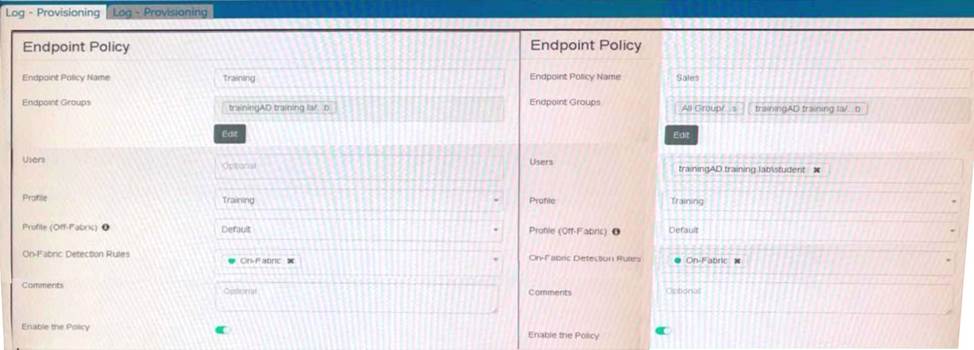
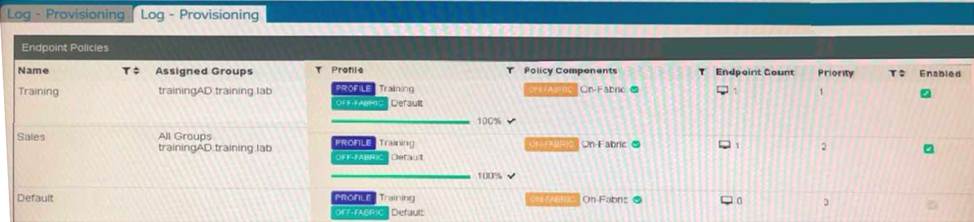


Which shows the configuration of endpoint policies.
Based on the configuration, what will happen when someone logs in with the user account student on an endpoint in the trainingAD domain?

A. FortiClient EMS will assign the Sales policy
B. FortiClient EMS will assign the Training policy
C. FortiClient EMS will assign the Default policy
D. FortiClient EMS will assign the Training policy for on-fabric endpoints and the Sales policy for the off-fabric endpoint

Explanation:
Based on the configuration shown in the exhibits:
There are three endpoint policies configured: Training, Sales, and Default.
The "Training" policy is assigned to the "trainingAD.training.lab" group.
The "Sales" policy is assigned to "All Groups" and "trainingAD.training.lab/student."
The "Default" policy has no specific groups assigned.
When someone logs in with the user account "student" on an endpoint in the "trainingAD" domain:
The "Training" policy is specifically assigned to the "trainingAD.training.lab" group.
The "Sales" policy includes "trainingAD.training.lab/student" but not the general "trainingAD.training.lab" group.
The system will prioritize the most specific match for the group.
Therefore, FortiClient EMS will assign the "Training" policy to the "student" account logging into the "trainingAD" domain as it matches the group "trainingAD.training.lab" directly.
Reference
FortiClient EMS 7.2 Study Guide, Endpoint Policy Configuration Section FortiClient EMS Documentation on Group Policy Assignment and Matching


Question#3

An administrator wants to simplify remote access without asking users to provide user credentials.
Which access control method provides this solution?

A. ZTNA full mode
B. SSL VPN
C. L2TP
D. ZTNA IP/MAC littering mode

Explanation:
Simplifying Remote Access:
The administrator wants to simplify remote access without asking users to provide user credentials.
Evaluating Access Control Methods:
ZTNA full mode can provide seamless access by leveraging device identity and posture, eliminating the need for user credentials for each access request.
Other methods like SSL VPN and L2TP typically require user credentials.
Conclusion:
The correct access control method that provides this solution is ZTNA full mode.
Reference: ZTNA section in the FortiGate Infrastructure 7.2 Study Guide​.

Question#4

An administrator has lost web access to the FortiClient EMS console, and the web page to access to the console is timing out.
How can the administrator gather information to investigate the issue? (Choose one answer)

A. Use the CLI diagnostic tool on the EMS server.
B. Download the webserver logs from the PostgreSQL server.
C. Use the diagnostic logs option from the FortiClient EMS GU
D. Download the log generator from the support site and run it on the EMS server.

Explanation:
According to the FortiClient EMS Administrator Study Guide and official Technical Tips from Fortinet, when the web console is inaccessible (e.g., timing out), the administrator must use tools available directly on the server's operating system (CLI) to gather diagnostic information.

Question#5

Which two are benefits of using multi-tenancy mode on FortiClient EMS? (Choose two.)

A. Separate host servers manage each site.
B. Licenses are shared among sites
C. The fabric connector must use an IP address to connect to FortiClient EM
D. It provides granular access and segmentation.

Explanation:
Understanding Multi-Tenancy Mode:
Multi-tenancy mode allows multiple independent sites or tenants to be managed from a single FortiClient EMS instance.
Evaluating Benefits:
Licenses can be shared among sites, making it cost-effective (B).
It provides granular access and segmentation, allowing for detailed control and separation between tenants (D).
Eliminating Incorrect Options:
Separate host servers managing each site (A) is not a feature of multi-tenancy mode. The fabric connector's use of an IP address (C) is unrelated to multi-tenancy benefits.
Reference: FortiClient EMS multi-tenancy configuration and benefits documentation from the study guides.

Disclaimer

This page is for educational and exam preparation reference only. It is not affiliated with Fortinet, FCP in Network Security, or the official exam provider. Candidates should refer to official documentation and training for authoritative information.

Exam Code: FCP_FCT_AD-7.4Q & A: 68 Q&AsUpdated:  2026-03-02

  Get All FCP_FCT_AD-7.4 Q&As
