- Welcome to CertQuestionsBank.com


Azure Databricks retires DeepSeek V4 Flash: what users should do next
Home / Azure Databricks retires DeepSeek V4 Flash: what users should do next
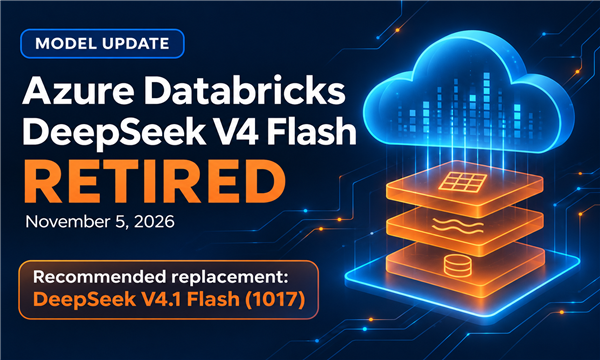
Azure Databricks retired the pay-per-token version of DeepSeek V4 Flash (0731) on November 5, 2026. Microsoft recommends DeepSeek V4.1 Flash (1017) as its replacement.
For teams still using the older model in experiments, notebooks, internal tools, or production workflows, the retirement requires more than changing a model name. The replacement should be tested against existing prompts and application requirements before it is treated as a direct substitute.
What has changed?
The retired model is:
● DeepSeek V4 Flash (0731)
● Offering type: Pay per token
● Retirement date: November 5, 2026
The recommended replacement is:
● DeepSeek V4.1 Flash (1017)
After retirement, applications that explicitly request the older model may stop working or return an availability error. The exact behavior can depend on how the application accesses the model and how the endpoint is configured.
This retirement applies to the model offered through Azure Databricks. It does not mean every DeepSeek model has been discontinued, nor does it automatically indicate a change to any Databricks certification exam.
Why a model replacement needs testing
A newer model can have different behavior even when it belongs to the same product family. Prompts that worked reliably with V4 Flash may produce different wording, formatting, reasoning paths, or refusal behavior with V4.1 Flash.
Structured output deserves particular attention. Applications often expect a model to return JSON, SQL, code, classifications, or text in a fixed format. A small difference in the response may break a downstream parser even when the answer looks correct to a person.
Teams should also check latency, token consumption, and output quality. The recommended replacement may be the closest available option, but "recommended" does not guarantee identical performance for every workload.
A practical migration checklist
Start by finding every reference to DeepSeek V4 Flash (0731). Check notebooks, model-serving configurations, application code, environment variables, deployment scripts, workflow definitions, and internal documentation.
Next, replace the retired model with DeepSeek V4.1 Flash (1017) in a test environment. Run the same prompts and representative data through both the old test results and the replacement model.
Pay close attention to:
● Structured response formats
● Tool and function calls
● Code generation
● Long-context prompts
● Safety and refusal behavior
● Response latency
● Token usage and cost
● Application-specific accuracy
Do not rely only on a few successful prompts. A useful test set should include normal requests, edge cases, malformed inputs, and examples that previously caused problems.
If the model supports a customer-facing or business-critical process, keep the migration reviewable. Record which prompts were tested, what changed, who approved the replacement, and how the team will monitor results after deployment.
What learners should know
The retirement also affects people using Azure Databricks for AI training and practice. A tutorial, lab, or notebook written for DeepSeek V4 Flash may no longer run without modification.
When following older learning material, check the model name before assuming the code is broken. Replacing the retired model may restore the workflow, but the generated results may differ from screenshots or sample answers in the course.
Learners should document those differences instead of forcing the new model to reproduce an old response word for word. The more useful question is whether the replacement still satisfies the task requirements.
Does this affect Databricks certification exams?
Microsoft has not presented this model retirement as a Databricks certification exam update. Candidates should not assume that an exam blueprint changed on November 5 simply because a hosted model was retired.
Certification changes should be verified through the relevant official exam guide or certification page. Product release notes are useful for hands-on preparation, but they are not a substitute for the published exam objectives.
Final takeaway
DeepSeek V4 Flash (0731) has reached the end of its availability in Azure Databricks, and DeepSeek V4.1 Flash (1017) is the recommended replacement.
The immediate task is simple: locate the old model references and update them. The responsible task takes a little longer. Teams should rerun their evaluations, confirm output compatibility, review operating costs, and monitor the replacement after deployment.
All third-party certification names, exam codes, and trademarks belong to their respective owners. Certquestionsbank is independently operated and is not affiliated with, endorsed by, or authorized by any certification provider.
Payment Methods
